Laser Therapy Physiotherapy Plan Richmond Hill: Laser Therapy is a noninvasive treatment that uses focused light energy to support tissue recovery and help manage pain. At Remedy Physio Clinic, it is used as part of care for musculoskeletal injuries, chronic conditions, degenerative conditions, and wounds, depending on the findings of a physiotherapy assessment and the needs of the individual patient.
What Is Laser Therapy?
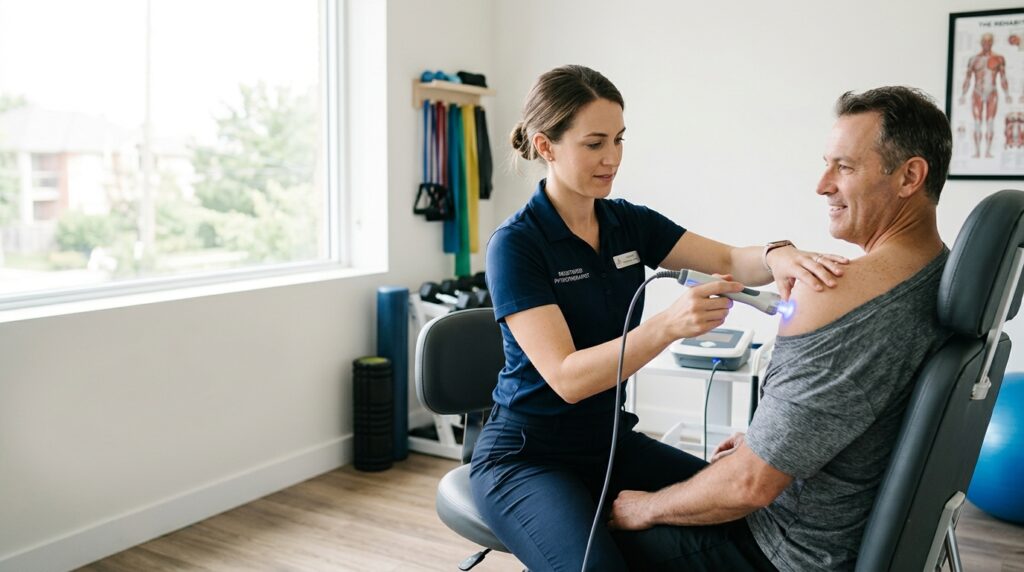
Laser therapy uses light produced by low intensity laser diode technology or high intensity super luminous diode technology. The clinician applies the light source to the treatment area so that light energy can reach the tissues below the skin. This is different from a surgical laser, which is designed to cut, remove, or cauterize tissue. Physiotherapy laser treatment does not involve an incision.
The purpose is to support the body’s natural biological processes at the cellular level. The light energy interacts with light sensitive molecules in tissue and may influence cellular activity involved in recovery. In practical terms, laser therapy may be used to support healing, ease symptoms, and help a patient participate more comfortably in movement and rehabilitation.
It is important to keep the purpose in perspective. Laser therapy is not a guaranteed cure, and it does not replace the work of identifying why pain or limited movement is occurring. Its value depends on the condition being treated, the stage of recovery, the patient’s health, and how it fits into the rest of the care plan. | Richmond Hill laser therapy

How Laser Therapy May Support Recovery | Laser Therapy Physiotherapy Plan Richmond Hill
When a muscle, tendon, ligament, joint, or other tissue is irritated or injured, pain can make ordinary movement and exercise difficult. A physiotherapist may consider laser therapy when supporting tissue recovery or reducing symptoms could make it easier to move, rebuild strength, and return to normal activity.
In plain terms, controlled light energy is delivered to a selected area to support processes within the tissue. It does not physically move a joint or load a muscle.
This is why laser therapy is generally an addition to active rehabilitation rather than a complete plan by itself. If weakness, stiffness, reduced balance, limited mobility, or a movement pattern is contributing to the problem, those issues may still need to be addressed through education and appropriate exercise.
What Happens During a Richmond Hill laser therapy Session?
Before treatment begins, the physiotherapist should assess the area and ask about your symptoms, medical history, current health, medications, previous treatment, and goals. This helps determine whether laser therapy is appropriate and where it may fit within care. You should have an opportunity to ask questions and provide informed consent.
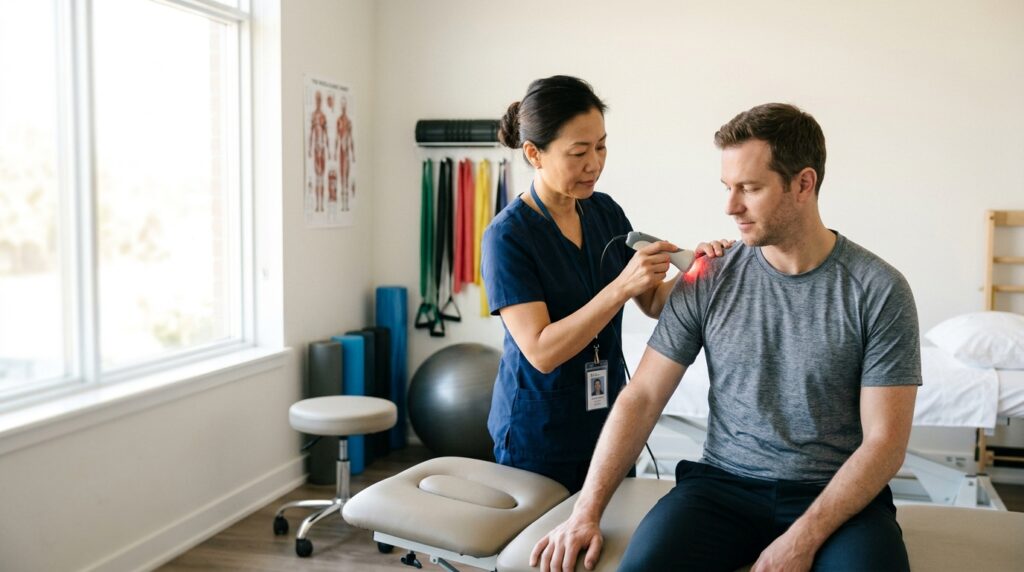
During treatment, the clinician positions the applicator over the selected area, often close to or touching the skin. Protective measures are used as required, and the provider should explain what you may notice and what to report.
Laser therapy does not involve needles or an incision. The experience can vary with the equipment, treatment area, and clinical plan, so it is better to ask what to expect in your particular case than to rely on a description from another patient. Afterward, the physiotherapist may reassess movement or symptoms and continue with other parts of the appointment, such as mobility work, manual therapy, or exercise.
What Types of Patients May Be Considered?
People searching for laser therapy Richmond Hill services often have a musculoskeletal injury, persistent pain, a degenerative condition, or an area that has been slow to heal. Laser therapy may be considered for selected muscle, tendon, ligament, joint, and soft tissue concerns. Remedy also describes it as an option used as part of care for wounds.
The name of a condition alone does not determine whether laser therapy is suitable. Two people with similar pain may have different contributing factors. One may need support before progressing exercise, while another may benefit more from strength, mobility, load management, or further medical assessment.
A useful consultation therefore focuses on your function as well as your symptoms. The physiotherapist may ask what movements are difficult, how the problem affects work or sleep, what activities you want to resume, and how your condition has responded to previous care.
Laser Therapy Within a Broader Physiotherapy Plan
Remedy offers laser therapy as one of several physiotherapy services in Richmond Hill, alongside options such as manual therapy, electrotherapy, rehabilitation exercise, and other approaches for physiotherapy laser treatment. The choice should be based on assessment findings rather than applying the same routine to every patient.
For many musculoskeletal concerns, active rehabilitation remains important. Exercise may restore motion, improve strength, and increase tolerance for activity. Education can help patients understand pacing, work demands, or ways to modify activity while healing.
Laser therapy may support that process when the physiotherapist believes it is appropriate. A personalized plan should explain why it is being recommended, what changes the clinician hopes to see, and how progress will be measured. If symptoms or functions do not respond as expected, the plan should be reviewed rather than repeated automatically.
Laser Therapy and Shockwave Therapy Are Different
Therapeutic laser treatment | Patients researching newer treatment options may also encounter shockwave therapy. Although both can be used within musculoskeletal care, they deliver different forms of energy and should not be treated as interchangeable.
Laser therapy delivers light energy through laser diodes or super luminous diodes. Shockwave treatment uses acoustic waves or mechanical pulses directed toward a localized treatment area. The sensation, clinical reasoning, and types of problems considered for each treatment can therefore differ.
One option is not automatically more advanced or more effective than the other. The appropriate choice depends on the tissue involved, the nature and duration of the problem, the level of sensitivity, relevant health considerations, and the goals of care. In some cases neither may be necessary, and exercise, education, manual therapy, or another form of care may be the more useful starting point.
Why a Full Assessment Matters |Laser Therapy Richmond Hill
Pain can come from many sources, and the place where you feel it is not always the only area needing attention. Treating the painful spot without understanding the wider picture can miss important factors.
A physiotherapy assessment should include a relevant history and physical examination. Depending on the concern, the physiotherapist may evaluate movement, strength, mobility, function, and signs that suggest a need for medical referral. The assessment also helps identify precautions or reasons why a proposed treatment may not be appropriate.
This process gives laser therapy a clear purpose. Instead of being selected simply because it is available, it becomes one possible tool connected to a working clinical explanation and measurable goals.
Setting Realistic Expectations
The response to laser therapy varies. Some patients may notice a change in symptoms or movement, while others may experience a more gradual response or find that another approach suits them better. No responsible clinic should promise an instant result, a guaranteed cure, or the same outcome for every condition.
Ask how the physiotherapist will judge whether laser treatment for pain is helping. Useful measures may relate to pain during a meaningful activity, range of motion, strength, walking, work tolerance, sleep, or the ability to complete rehabilitation exercises. Progress should be reviewed in relation to your goals, not only by how the area feels immediately after treatment.
The larger aim is to help you return to the activities that matter to you with greater comfort, confidence, and physical capacity. Laser therapy may support that aim, but the plan should continue to evolve with your response.
If you are considering laser therapy for an injury or laser treatment for pain, persistent pain, therapeutic laser treatment, or a slow healing concern, book an appointment with Remedy Physio Clinic to discuss whether it may be appropriate for you.
Laser therapy is one part of a personalized care plan and is not a replacement for a full physiotherapy assessment. The assessment helps determine whether laser therapy or another treatment option belongs in your care. | Laser therapy near me
Frequently Asked Questions | Laser Therapy Richmond Hill
Laser therapy is a noninvasive treatment that uses focused light energy to support tissue recovery and help manage symptoms. Remedy Physio Clinic uses low-intensity laser diode technology or high-intensity super-luminous diode technology as one possible part of physiotherapy care.
Laser therapy may be considered as part of care for musculoskeletal injuries, chronic conditions, degenerative conditions, and wounds. Whether it is appropriate depends on the condition, assessment findings, health history, and individual treatment goals.
The clinician directs light energy toward the selected treatment area. This energy interacts with light-sensitive molecules in the tissue and may influence cellular processes involved in recovery.
The clinician positions an applicator over the treatment area, often close to or touching the skin. Protective measures are used when required, and the clinician should explain what you may notice during treatment.
No. Physiotherapy laser treatment does not require needles or an incision. It is different from a surgical laser, which is designed to cut, remove, or cauterize tissue.
The experience can vary depending on the equipment, treatment area, and clinical plan. Your physiotherapist should explain what to expect and ask you to report any unexpected or uncomfortable sensations.
There is no fixed number suitable for every patient. Recommendations depend on the condition, its severity, the stage of recovery, individual goals, and how the patient responds to treatment.
Laser therapy delivers light energy using laser or super-luminous diodes. Shockwave therapy uses acoustic waves or mechanical pulses, so the sensation, clinical reasoning, and conditions considered for each treatment may differ.
Laser therapy is generally used as one part of a broader care plan rather than as a replacement for assessment, education, movement, or exercise. Other contributing factors such as weakness, stiffness, or reduced mobility may still need active rehabilitation.
A physiotherapy assessment is needed to understand your symptoms, medical history, movement, and goals. The physiotherapist can then explain whether laser therapy may be useful or whether another treatment option would be more appropriate.
Please fell free to read our client's testimonials on our Google page or leave us a review about your personal experience at Remedy Physio Clinic. Understanding Shockwave Therapy > Read about Shockwave Therapy